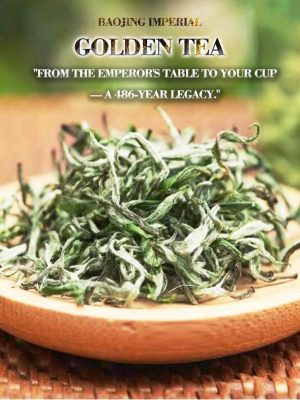
In 1539, during the Ming Dynasty, a high-ranking official led his troops through the mountains of Baojing, Hunan. A mysterious fever swept through the army. A local Miao woman offered them a cup of tea brewed from ancient leaves.
The fever vanished.
Grateful, the official rewarded her with one liang of gold — a fortune in that era — for just one liang of tea. Thus was born the legend: “One Liang of Gold for One Liang of Tea.”
For centuries, this tea remained a closely guarded secret of the imperial court. Today, the very same 2057 ancient tea trees from the Ming and Qing dynasties still thrive in the misty mountains of Baojing. The oldest of them, the “King Tea Tree,” is over 417 years old — a living cultural relic you can taste.
Golden Tea — a sip of imperial history, now in your cup.
Imperial Freshness
The amino acid content reaches 7.47%, which is 2-3 times that of regular green tea.
Distinctive Aroma
The linalool content is 115%-164% higher than the control variety, creating a unique aroma similar to that of roses.
Living Antiquity
There are currently 2,057 ancient tea trees from the Ming and Qing dynasties, with the oldest being 417 years old, and it's the only living plant intangible cultural heritage in Hunan Province.
Nation-Recognized
National Geographic Indication protected products, selected for the China-EU Geographic Indication mutual recognition agreement
Healthy weight loss lifestyle
Golden Ratio
The "Four Excellences"
Fragrant, green, refreshing, mellow—rich aroma, bright green color, fresh taste, and a sweet aftertaste
Living Antiquity
There are currently 2,057 ancient tea trees from the Ming and Qing dynasties, with the oldest being 417 years old, and it’s the only living plant intangible cultural heritage in Hunan Province.
Pure & Natural
Grown in China’s core selenium-rich region, from natural ecological tea gardens, no pesticide residues, SGS internationally certified
Golden Ratio
Tea polyphenols are about 20%, water extracts nearly 50%, chlorophyll is over 50% higher, and the phenol-to-amino ratio perfectly hits the 3:5 golden range, making the tea bright and refreshing without being astringent.
Nation-Recognized
National Geographic Indication protected products, selected for the China-EU Geographic Indication mutual recognition agreement